About
Testing real-world grassland restoration scenarios at the biodiversity-climate-livelihood nexus
Aims
Living Grasslands explores how restoring grassy ecosystems can benefit both people and nature. Working with local partners in the montane grasslands of the uMzimvubu Catchment in South Africa’s Eastern Cape, we use the landscape as a “living lab” to test real-world wilding scenarios that strengthen biodiversity and support local livelihoods.
The uMzimvubu is South Africa’s third-largest river catchment and one of the country’s last major systems that remain undammed. The area is rich in biodiversity and endemism, but faces high levels of poverty and unemployment. A growing number of innovative restoration and conservation initiatives foster a gradient of diverse land uses, land tenures and restoration levels. Together with local citizen scientists, this allows us to perform space-for-time experiments to test how these existing restoration interventions affect plant and animal diversity and related ecosystem services. We will combine this scientific knowledge with indigenous knowledge about how biodiversity is valued for ecotourism, traditional medicine, wild foods, and recreational and esthetic values.
By sharing our findings and unique transdisciplinary approach locally and internationally, we aim to influence communities and policymakers to advance wilding as a Nature-based Solution (NbS) in grasslands globally.
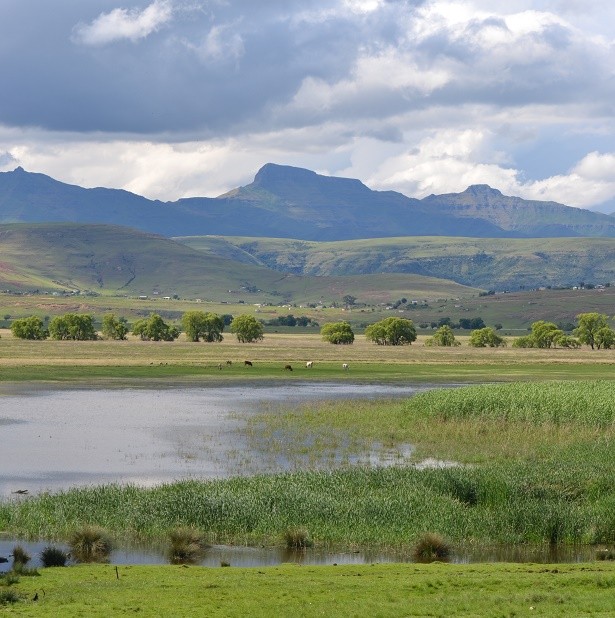 Photo: ERS
 Photo: ERS
 Photo: ERS
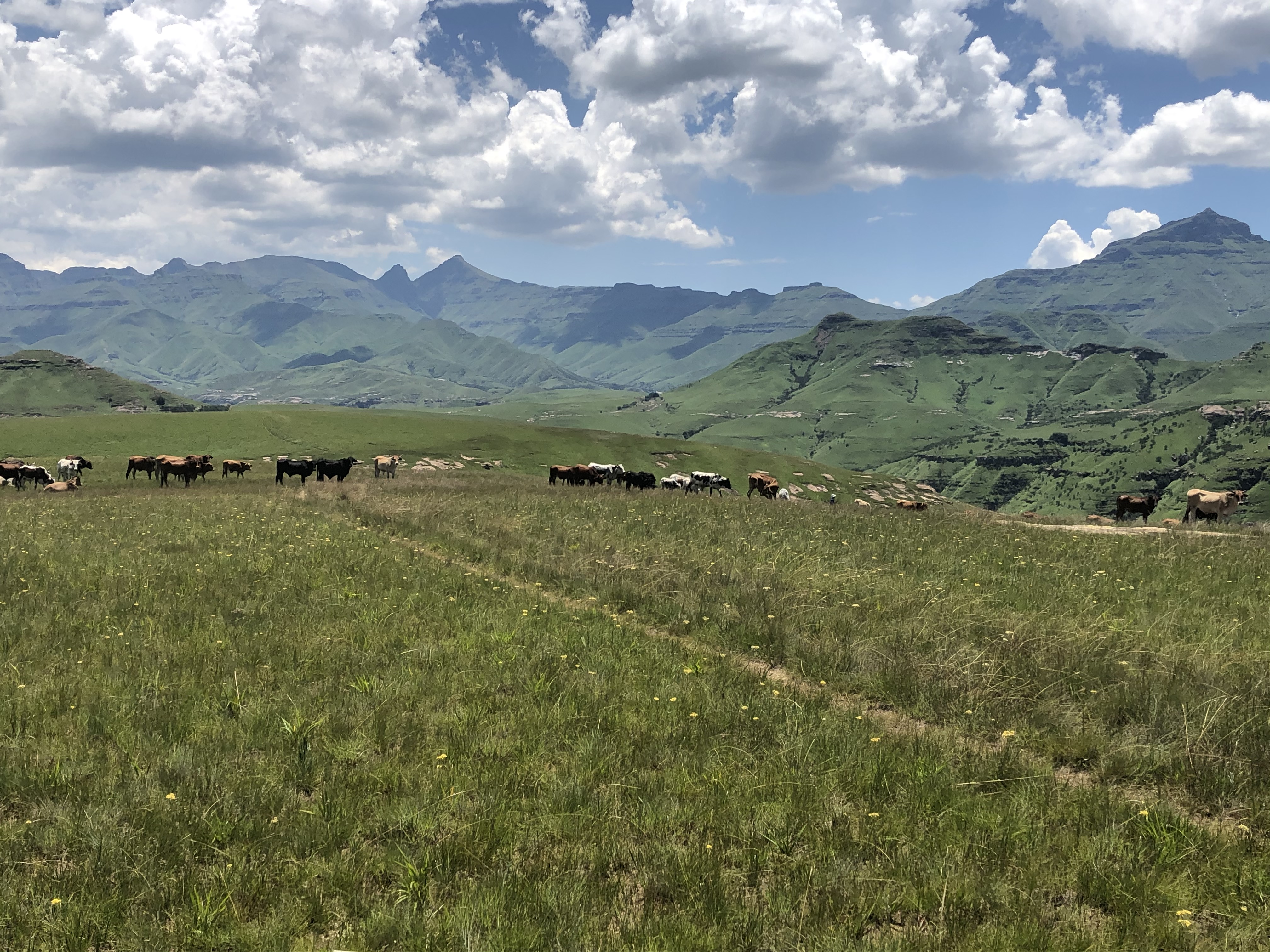 Photo: ERS
Why is this relevant?
Grassy ecosystems cover about 40% of land on Earth but only 8% of global grasslands are under some form of protection. They are among the systems most threatened by land-use change such as mining, conversion to agricultural land, and afforestation. Despite their importance for biodiversity, carbon storage, water provisioning, and livelihoods, very few grassy ecosystems have been targeted for NbS. This is particularly true for the Global South that includes most of the world’s grassy ecosystems. Our project co-creates and evaluates (re)wilding as NbS for grassy ecosystems, with a focus on a South African catchment threatened by wildlife extirpation, habitat loss, unplanned fire and grazing, and invasive alien plants.
Our approach
Living Grasslands addresses this challenge through a transdisciplinary collaboration between three South African and two European universities, two NGOs that have been active in the landscape for decades (Conservation South Africa, Environmental & Rural Solutions), and the local communities and private landowners in the area. As a team, we work together to:
- Understand locally held biodiversity values and meanings by engaging communities to explore how they perceive biodiversity and the diverse values they associate with its different components,
- Establish participatory monitoring hubs where community members and scientists jointly monitor biodiversity and associated livelihood values,
- Integrate local and scientific knowledge to co-create potential pathways to restore healthy, reciprocal relationships between people and nature.
Through these objectives, the project aims to develop ecological and biodiversity restoration scenarios in an inclusive way, building on the needs, visions and indigenous knowledge of the people living in the living lab, and determine the trade-offs and synergies in these scenarios for biodiversity and people across diverse land tenure systems and ecological gradients.
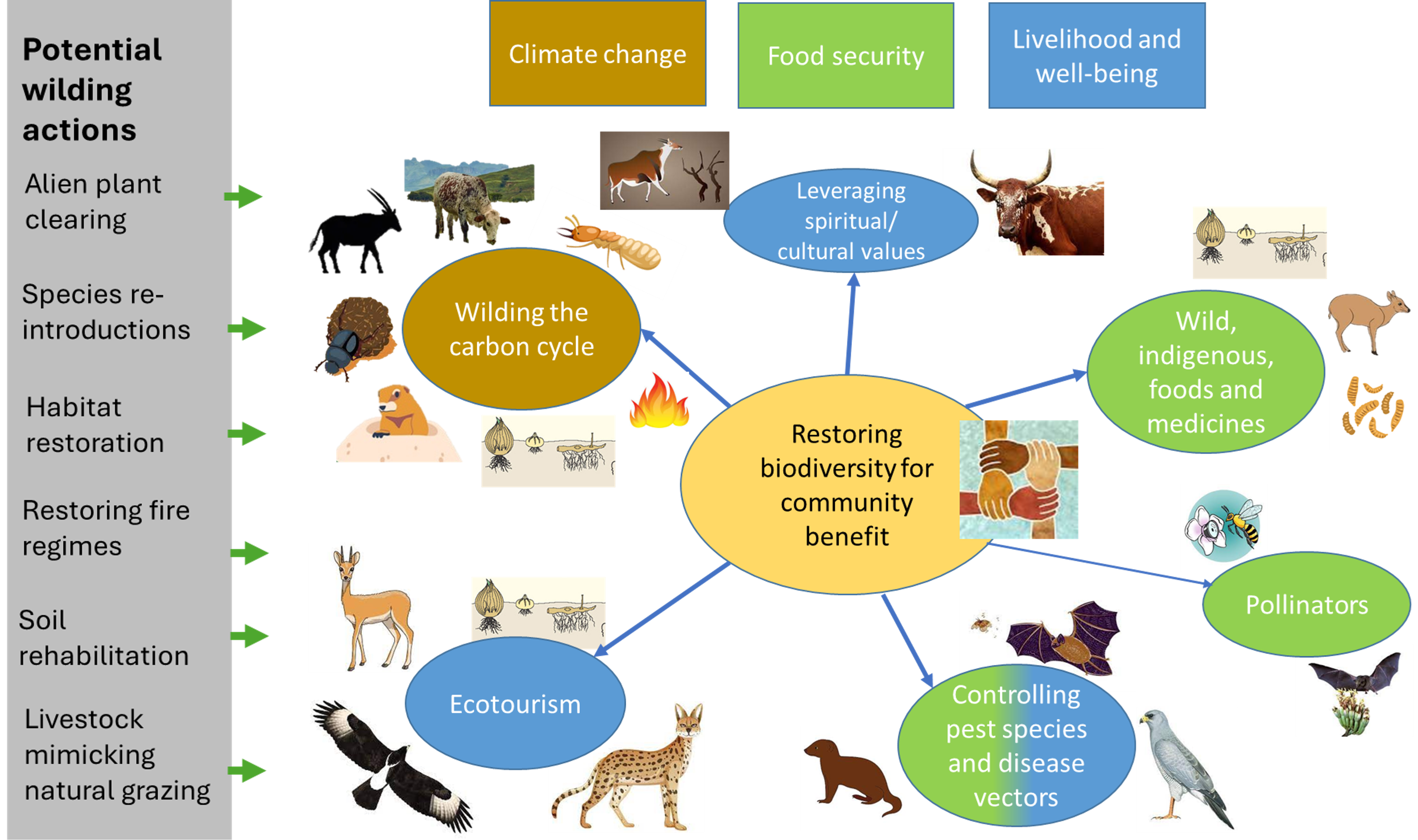
Wilding actions with gradients in the study area and the potential ecosystem services supported by them.
Figure by Joris Cromsigt